
Bikes / Additive Titanium
Additive Titanium
Form created by structure.
Advanced titanium structures made possible through additive manufacturing.
Manifesto
Additive Titanium asks a different question than a traditional frame: not which standard tube shape to bend, but what structure the load path actually calls for. Additive manufacturing lets that structure exist.
The Purpose
For riders and engineers who want a frame shaped by structural logic — internal lattice and organic load paths where they matter, rather than a shape limited by what a tube-bending machine can produce.
Material Architecture
How It's Built
Titanium powder-bed 3D printing forms structurally optimized junctions — seat clusters, bottom brackets and dropouts — with internal lattice geometry, later joined to conventional or additive tubing.
Key Engineering Details
What Sets This Platform Apart
- 01
Topology-Optimized Junctions
Junction geometry follows simulated load paths rather than a standard tube-to-tube shape.
- 02
Internal Lattice Structures
A lattice structure is applied to the material surface to simultaneously optimize stiffness and weight.
- 03
Design Freedom at the Joint
Additive manufacturing removes many of the shape constraints of welding or casting a junction.
- 04
Post-Process Verification
Printed components are inspected and post-processed before being integrated into a frame.
Geometry
Built Around Rider Position
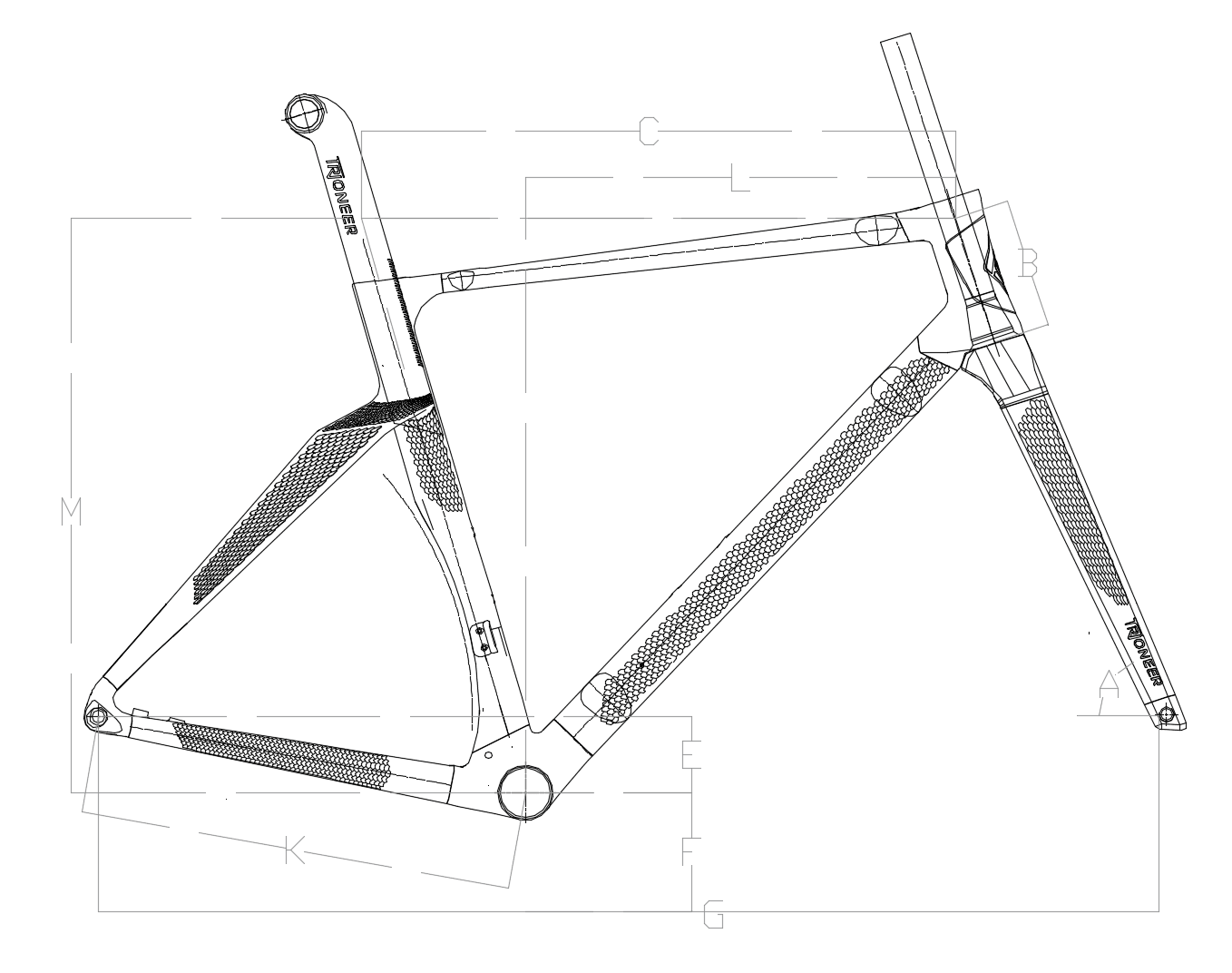
| Size | Rider Height (cm) | Seat Tube (mm) | Effective Top Tube (mm) | Head Tube (mm) | Head Angle (°) | Seat Angle (°) | Fork Length (mm) | Fork Offset (mm) | Chainstay (mm) | Front Center (mm) | BB Drop (mm) | Stack (mm) | Reach (mm) | Standover Height (mm) | Crankarm Length (mm) | Stem Length Suggestion (mm) | STR |
|---|---|---|---|---|---|---|---|---|---|---|---|---|---|---|---|---|---|
| XS/47 | 155–167 | 448.5 | 515.5 | 100 | 71.5 | 74.5 | 377 | 45 | 405 | 570.7 | 74 | 506.7 | 372.5 | 721.4 | 160/165 | 80/90 | 1.36 |
| S/52 | 165–175 | 467 | 537.6 | 115 | 72.3 | 74.0 | 377 | 45 | 405 | 583.2 | 73 | 526.4 | 386.7 | 739.5 | 165/170 | 90/100 | 1.36 |
| M/54 | 172–185 | 480.8 | 552.3 | 135 | 72.5 | 73.6 | 377 | 45 | 405 | 593.2 | 72 | 545.2 | 392.5 | 752.1 | 170 | 100 | 1.39 |
| L/56 | 182–192 | 502.0 | 565.6 | 152 | 73.0 | 73.3 | 377 | 45 | 405 | 598.8 | 72 | 563.1 | 397.3 | 775 | 172.5 | 110 | 1.42 |
| XL/58 | 190–195 | 522 | 580.0 | 175 | 73.3 | 73.0 | 377 | 45 | 405 | 610.5 | 72 | 586.2 | 405 | 795.0 | 175 | 120 | 1.45 |
| XXL/61 | 193 | 550.0 | 601.0 | 190 | 73.3 | 72.5 | 377 | 45 | 405 | 621.7 | 72 | 598.5 | 412.0 | 820.0 | 175 | 120 | 1.45 |
Personalization
Make It Yours
Choose a starting configuration below. Every detail is confirmed with you individually during the Bespoke Process.
Junction Finish
Anodizing Accent
Logo Style
Your configuration: As-Printed Texture · Violet Titanium · Laser-Etched
Testing & Validation
Printed junctions undergo dimensional inspection and structural validation before entering a frame build.
Simulation
Load cases and structural behaviour are modelled before anything is cut or printed.
Physical Prototyping
Prototype units are built to confirm fit, structure and manufacturing process.
Bench Testing
Completed structures are tested for alignment, strength and durability.
Gallery
Ready to Build Your Additive Titanium?
Begin with a private consultation, request pricing, or submit your fit data to start the Bespoke Process.